
DuPage County Dissolution of Marriage
DuPage County is the second largest county in Illinois, with more than 937,000 residents. Dissolution of marriage cases in DuPage County are filed with the Circuit Clerk and processed through the 18th Judicial Circuit's Domestic Relations Division in Wheaton. The DuPage Circuit Clerk office offers online case lookup, e-filing, and in-person access to dissolution records. Whether you need to search a past case, get a certified copy of a judgment, or understand the filing process, this guide covers what you need to know about dissolution of marriage in DuPage County.
DuPage County Quick Facts
DuPage County Circuit Clerk Office
Clerk Candice Adams oversees the DuPage County Circuit Clerk office, which handles all dissolution of marriage filings in the 18th Judicial Circuit. The main mailing address is P.O. Box 707, Wheaton, IL 60187-0707. The Domestic Relations Division is located at 505 N. County Farm Rd., Wheaton, IL 60187. This division handles dissolution of marriage, legal separation, paternity, and foreign judgment matters for DuPage County.
For questions about Domestic Relations matters, you can reach the division directly. The fax number is 630-407-8862. Email contact is available through Kenton Skarin at Kenton.Skarin@dupagecourts.gov. The division secretary, Christine Malinowski, can also assist at 630-407-8854. The main clerk phone number is 630/407-8700. Staff can look up dissolution of marriage cases by name or case number and tell you what documents are in the file.
The DuPage Circuit Clerk website at dupagecircuitclerk.gov is a full-service portal for DuPage County court records. You can search cases, pay fees, and learn about filing requirements all in one place.
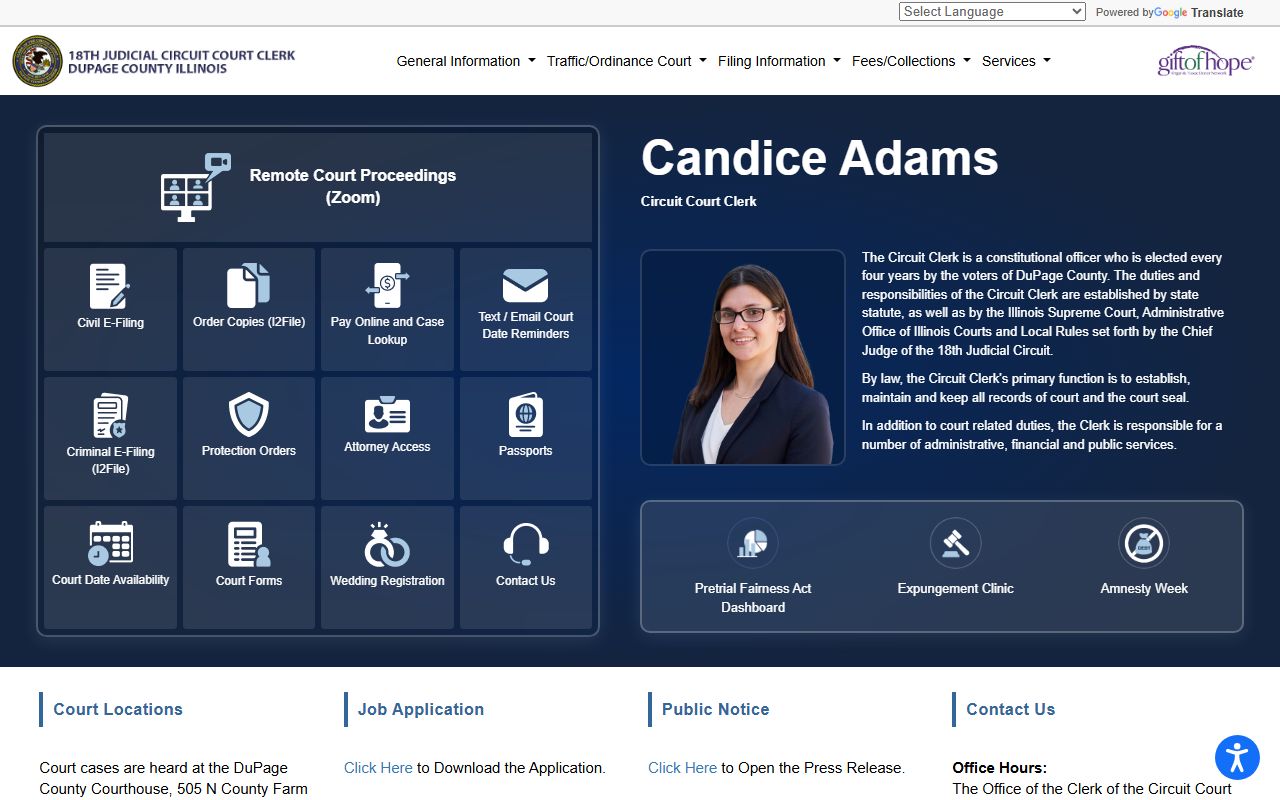
The DuPage Circuit Clerk main site at dupagecircuitclerk.gov provides online access to dissolution of marriage case records, filing information, and fee schedules for DuPage County.
| Circuit Clerk | Candice Adams |
|---|---|
| Main Address (Mail) | P.O. Box 707 Wheaton, IL 60187-0707 |
| Domestic Relations Division | 505 N. County Farm Rd. Wheaton, IL 60187 |
| Phone | 630/407-8700 |
| Domestic Relations Fax | 630-407-8862 |
| Domestic Relations Email | Kenton.Skarin@dupagecourts.gov |
| Division Secretary | Christine Malinowski, 630-407-8854 |
| Judicial Circuit | 18th Circuit |
| Website | dupagecircuitclerk.gov |
Online Dissolution Record Search for DuPage County
DuPage County offers one of the most accessible online record systems in Illinois. The Circuit Clerk's court records page at dupagecircuitclerk.gov/court-records.html provides free public access to dissolution of marriage case information. You can search by party name or case number. Results show case status, parties involved, court dates, and the assigned judge. This is useful for finding basic information about a dissolution case without going to the courthouse.
DuPage County also has an online payment and search system at epay.dupagecircuitclerk.gov. This portal lets you pay court fees online and look up case information at the same time. It is designed for parties who are actively involved in cases, but members of the public can use the search function to find dissolution records. Both portals are available around the clock, which makes DuPage County one of the more convenient counties for online record access in Illinois.
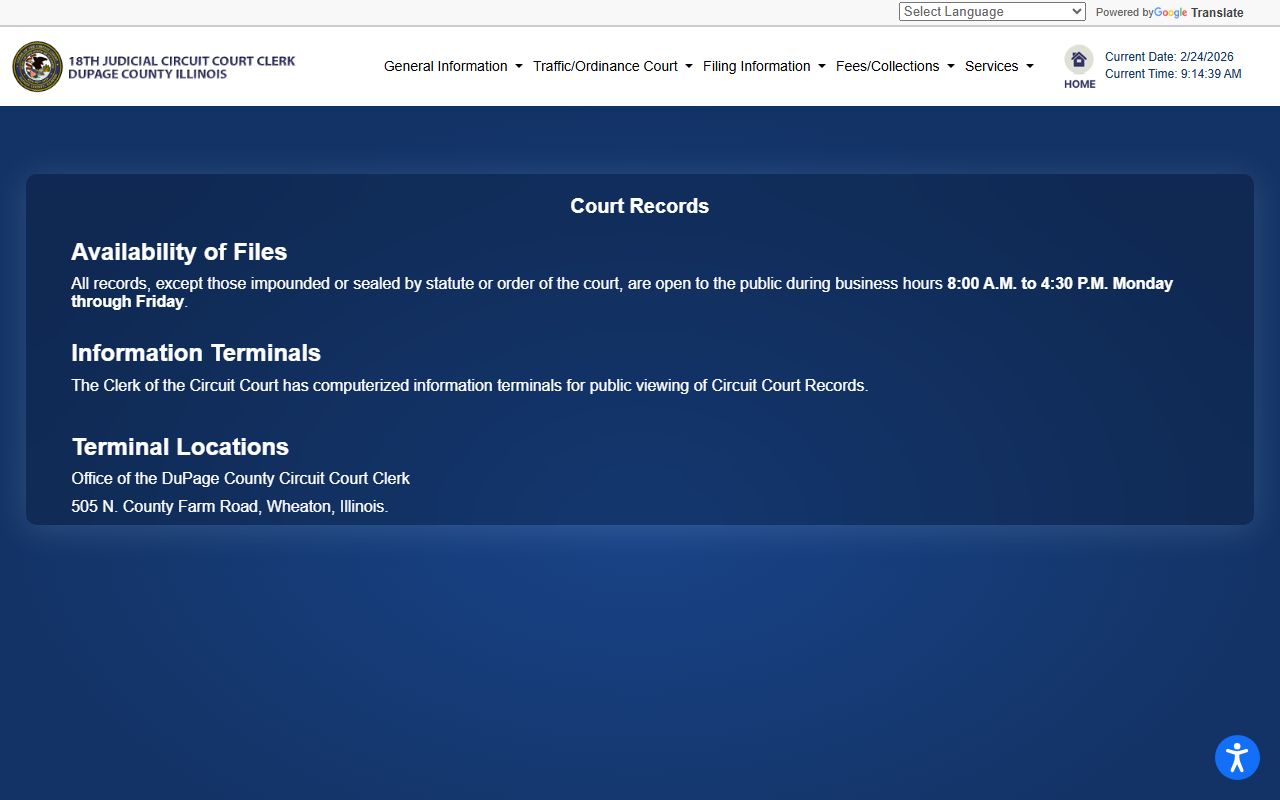
The DuPage Circuit Clerk court records search page at dupagecircuitclerk.gov/court-records.html lets the public search dissolution of marriage cases in DuPage County at no cost.
For document copies not available online, contact the clerk at 630/407-8700 or visit the Wheaton courthouse. Staff can pull the file, make copies, and process your request same day in most cases. Large files or older records may take more time.
Dissolution Record Fees in DuPage County
DuPage County has a specific fee schedule for dissolution of marriage document copies. The first page of any document copy costs $2.00. Pages two through twenty cost $0.50 each. Any page beyond twenty costs $0.25 each. Certification of a document costs $6.00 per document, added on top of the per-page copying fee. These fees are set by 705 ILCS 105, the Illinois Clerks of Courts Act.
Filing a new dissolution of marriage case in DuPage County requires payment of filing fees at the time of submission. E-filing has been mandatory in DuPage County for civil cases since January 1, 2016. All dissolution filings must go through an approved electronic filing manager. This means you cannot walk in and hand a paper petition to the clerk for a new case. The e-filing system is linked from the Circuit Clerk's website at dupagecircuitclerk.gov. The filing fee amount depends on the type of case and what motions you file with your initial petition.
If you cannot afford the fees, ask the clerk about the indigency fee waiver. You fill out an affidavit about your income and expenses. The judge reviews it and decides whether to waive some or all fees in your DuPage County dissolution case.
Dissolution of Marriage Law and the 18th Judicial Circuit
DuPage County dissolution of marriage cases are governed by 750 ILCS 5, the Illinois Marriage and Dissolution of Marriage Act. The 18th Judicial Circuit applies this law to all cases filed at the Wheaton courthouse. Illinois is a no-fault state. The only ground for dissolution recognized by the court is irreconcilable differences. One spouse does not need to prove fault by the other to get a dissolution in DuPage County.
Under 750 ILCS 5/401, at least one party must have lived in Illinois for 90 days before filing. You file in the county where you or your spouse lives. Most DuPage County residents file at the Wheaton courthouse. The Domestic Relations Division at 505 N. County Farm Rd. handles all dissolution, legal separation, and paternity matters. After filing, the other spouse must be served with the petition. DuPage County uses a standard Illinois process for service of process.
Property division in DuPage County follows 750 ILCS 5/503, which requires equitable distribution of marital assets and debts. The court does not automatically split things 50/50. Judges in the 18th Circuit weigh factors like length of marriage, each spouse's income and contributions, and future earning capacity. Child support follows the income shares formula under 750 ILCS 5/505. Both parents' gross incomes go into the formula, and the result is an obligation from one parent to the other. DuPage County courts take child support seriously and enforce orders strictly.
Couples with no children, a short marriage, and minimal shared assets may qualify for the Joint Simplified Dissolution under 750 ILCS 5/452. This process is faster, cheaper, and involves fewer court appearances. Both parties must agree on all terms. If you think you qualify, ask the Domestic Relations Division at the Wheaton courthouse before filing a full dissolution case. The clerk's staff can tell you whether your situation fits the simplified criteria.
What DuPage County Dissolution Records Contain
A dissolution case file in DuPage County can be large. It starts with the petition for dissolution of marriage, which states the grounds, the names of both spouses, and what relief is being requested from the court. The other spouse files a response, which may agree or contest the petition. Both parties submit financial disclosure statements listing income, property, and debts. If children are involved, proposed parenting plans go into the file early in the case.
As the case moves forward, the file grows to include temporary orders for support or custody, discovery documents if contested, mediation records if ordered by the court, and attorney fee petitions if applicable. All of these become part of the public record in DuPage County once filed. The final document everyone seeks is the judgment of dissolution of marriage. This is the court's order ending the marriage. It includes all of the terms: property and debt division, maintenance if ordered, the parenting plan with custody and visitation, and child support amounts.
Certified copies of the DuPage County judgment are often needed for legal and financial matters. Banks, mortgage companies, Social Security offices, and state agencies may ask for this document when you change your name, sell a home, or update benefits. Get certified copies from the Circuit Clerk at the Wheaton courthouse. Under 5 ILCS 140, dissolution records in DuPage County are public. Illinois Supreme Court Rule 138 requires personal identifiers to be removed from public copies before release.
- Petition for dissolution of marriage
- Financial disclosure affidavits
- Temporary orders for support or custody
- Parenting plan and custody agreement
- Marital settlement agreement
- Judgment of dissolution of marriage
- Post-decree modification orders
IDPH Verification for DuPage County Dissolutions
The Illinois Department of Public Health tracks dissolution of marriage records statewide, including DuPage County cases from 1962 to the present. The IDPH can confirm that a dissolution took place and provide basic facts: the names, the county where it was filed, and the date of judgment. This is a verification only. For certified copies of the actual dissolution judgment in DuPage County, you must contact the Circuit Clerk in Wheaton.
IDPH verification costs $5.00 per search. Submit a written request with a check or money order payable to "Illinois Department of Public Health." Processing takes four to six weeks by mail. Do not send cash. Mail requests to 925 E. Ridgely Ave, Springfield, IL 62702-2737. Call IDPH at (217) 782-6554 with questions. Full details and the request form are on the IDPH dissolution of marriage records page.
Legal Help for Dissolution Cases in DuPage County
DuPage County residents have access to several legal resources for dissolution of marriage cases. Illinois Legal Aid Online at illinoislegalaid.org offers free, plain-language guides on dissolution law in Illinois. The site explains each phase of the process, from filing through the final judgment. For people who cannot afford an attorney, the site's Easy Form tool walks users through filling out standard dissolution paperwork used in DuPage County courts.
The Illinois Supreme Court provides standardized forms for dissolution cases. These include the petition, financial affidavit, parenting plan, and judgment forms. They are available at the Illinois Courts forms page. DuPage County's 18th Judicial Circuit accepts these forms. Because e-filing is mandatory in DuPage County, you will need to upload these forms through an approved electronic filing system rather than hand-delivering paper copies to the courthouse.
The DuPage County Bar Association Lawyer Referral Service can connect you with a local family law attorney. DuPage County Legal Aid also provides limited free legal help to residents who meet income guidelines. If domestic violence is a factor in your dissolution case, the Domestic Violence Helpline and court advocates at the Wheaton courthouse can assist you through the process.
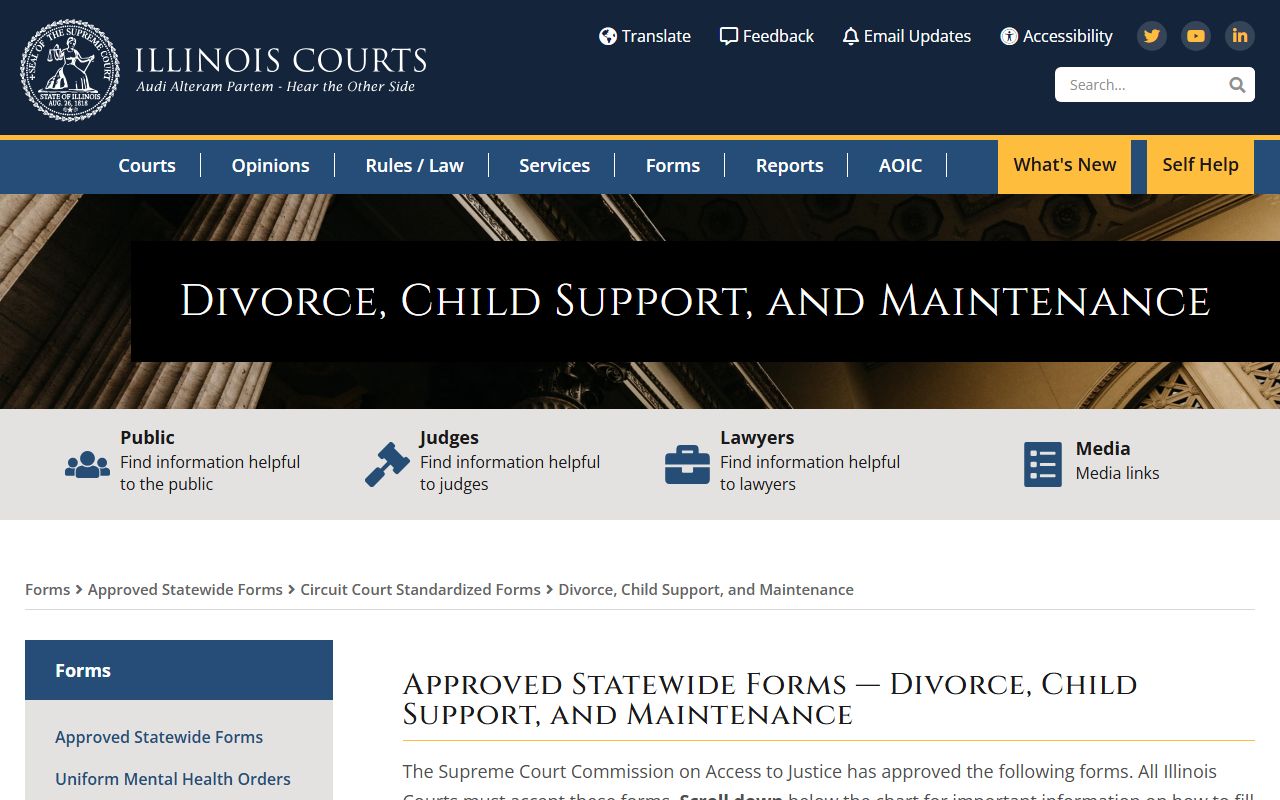
Illinois Supreme Court approved forms are required for dissolution filings in DuPage County and are available for download from the Illinois Courts website.
Cities in DuPage County
DuPage County contains several large cities. The qualifying cities below have their own pages on this site. All dissolution of marriage cases for DuPage County residents are filed at the 18th Judicial Circuit courthouse in Wheaton, regardless of which city you live in.
Other communities in DuPage County include Elmhurst, Glen Ellyn, Lisle, Carol Stream, Addison, Glendale Heights, Bolingbrook, Westmont, Villa Park, Lombard, Oak Brook, Woodridge, and Darien. All residents file dissolution cases at the Wheaton courthouse.
Nearby Counties
These counties border DuPage County. Each has its own circuit court for dissolution of marriage filings. File in the county where you or your spouse currently lives to make sure the court has proper jurisdiction over your case.