
Find Dissolution of Marriage in Marshall County
Marshall County dissolution of marriage records are kept by the Circuit Clerk's office in Lacon, the county seat. The 10th Judicial Circuit covers Marshall County along with several other central Illinois counties. All dissolution cases filed in Marshall County go through the circuit court in Lacon. This page explains how to search for dissolution of marriage records in Marshall County, what the process involves under Illinois law, what fees to expect, and where you can find legal help if you need it.
Marshall County Quick Facts
Marshall County Circuit Clerk
Circuit Clerk Gina M. Noe manages court records in Marshall County, including all dissolution of marriage cases. The office is at 122 N. Prairie in Lacon. When you file for dissolution in Marshall County, the clerk accepts the petition, assigns a case number, and stores the file. You can request copies of court documents, check case status, and get certified copies of judgments from this office. The staff is the best source for information on what documents are needed and what fees apply.
Marshall County is a smaller rural county in the 10th Judicial Circuit. The 10th Circuit covers Marshall, Peoria, Putnam, Stark, and Woodford counties. Cases in Marshall County are heard in the Lacon courthouse. Because the county has a smaller population, the clerk's office handles a lower volume of filings than urban counties, which can make turnaround times faster. Call 309/246-6435 before visiting to confirm the clerk's current hours and what you need to bring.
| Circuit Clerk | Gina M. Noe |
|---|---|
| Address | 122 N. Prairie, P.O. Box 328, Lacon, IL 61540 |
| Phone | 309/246-6435 |
| Fax | 309/246-2173 |
| Judicial Circuit | 10th Judicial Circuit |
| Hours | Monday through Friday, 8:00 AM to 4:30 PM |
Searching Marshall County Dissolution Records Online
Marshall County is part of the Judici court records system. Judici provides free public access to court dockets and lets you search by party name or case number. You can find dissolution of marriage cases filed in Marshall County and see basic information like the filing date, case status, and scheduled hearings. This is a fast way to check whether a case exists before contacting the clerk's office in Lacon.
For documents, you need to visit the courthouse or submit a mail request. Online access through Judici does not include document images for most Marshall County cases. The clerk's staff can search by name if you do not have a case number. For older cases not in the Judici system, a visit to the Lacon courthouse may be necessary to view physical records. The Illinois Courts website at illinoiscourts.gov lists all circuit court clerk offices and their contact information.
The screenshot below shows the Judici court records platform, which covers Marshall County dissolution of marriage cases among its statewide database.
Judici provides free online access to dissolution of marriage dockets in Marshall County and other Illinois counties.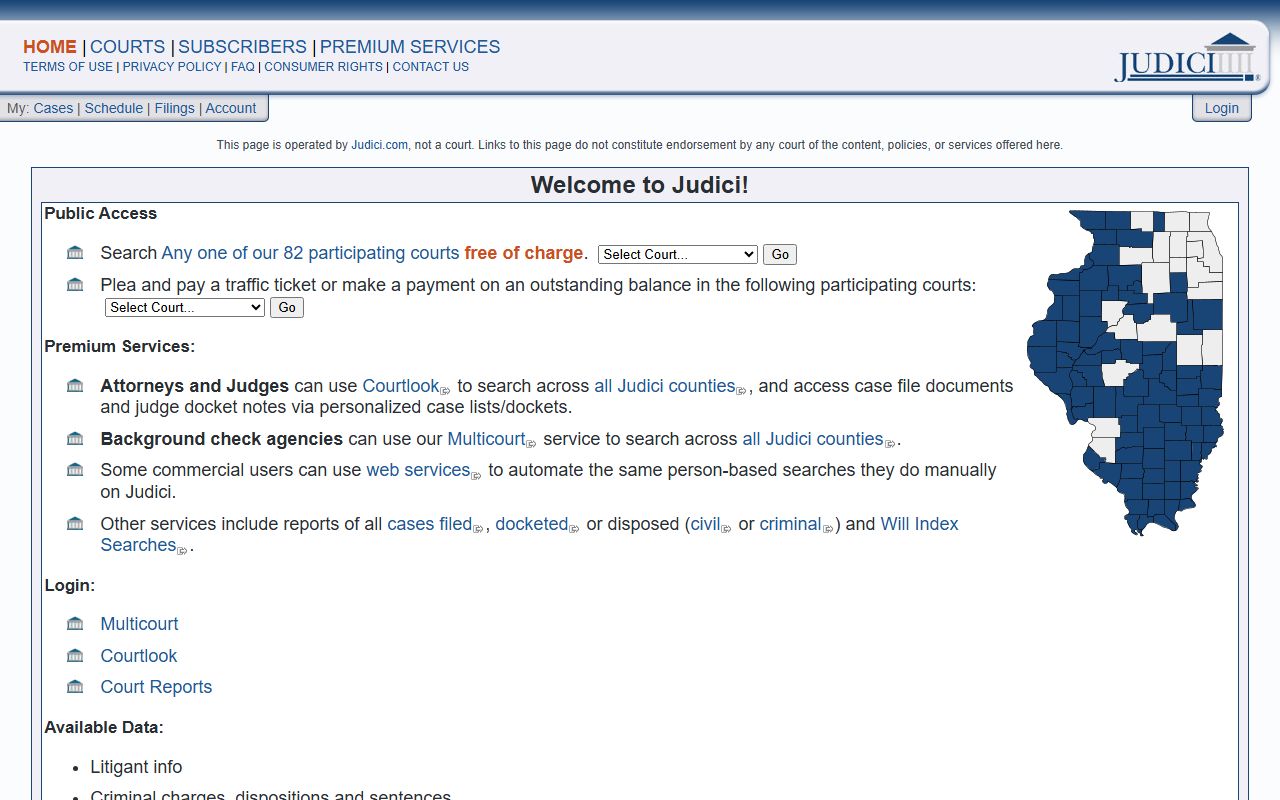
Judici is the most practical free tool for finding whether a dissolution of marriage was filed in Marshall County without needing to visit the Lacon courthouse.
Dissolution of Marriage Fees in Marshall County
Filing fees for dissolution of marriage in Marshall County are governed by Illinois law, with the circuit court collecting fees set by the state and the county. The standard petition fee runs from approximately $289 to $388 in most 10th Judicial Circuit counties. The responding party pays an appearance fee. Certified copies of the dissolution judgment cost a per-page fee. Call the Marshall County Circuit Clerk at 309/246-6435 for exact current amounts before you file or request records.
Mail requests for document copies should include a check or money order payable to the Marshall County Circuit Clerk, the names of both parties, the approximate year of the dissolution, and a self-addressed stamped envelope. If you need certified copies, note that specifically in your request, as the fee is higher than for plain copies. Processing times in Marshall County tend to be relatively quick given the smaller caseload compared to larger counties.
If you cannot afford the filing fee, you may apply for a fee waiver by asking for the Application to Sue or Defend as an Indigent Person form. The court weighs your income against the federal poverty guidelines and your household expenses. Qualifying applicants pay no fees for their dissolution of marriage case in Marshall County.
Illinois Dissolution of Marriage Law and Process
Marshall County follows Illinois state law for dissolution of marriage cases. The Illinois Marriage and Dissolution of Marriage Act, codified at 750 ILCS 5/, governs all aspects of the process. This includes the residency requirement, grounds, property division, child support, maintenance, and the procedures for the final judgment. Illinois requires at least one spouse to have lived in the state for 90 days before filing, which is set out in 750 ILCS 5/401.
Illinois does not recognize fault-based divorce. Irreconcilable differences is the only ground for dissolution under Illinois law. When spouses have lived separately for six months, the court considers irreconcilable differences to be established automatically. The process in Marshall County starts with a petition filed at the clerk's office in Lacon. The other spouse is served, has 30 days to respond, and the case proceeds from there through negotiation or hearings.
Property is divided equitably under 750 ILCS 5/503. This means fair, not necessarily half and half. The court looks at factors like how long the couple was married, what each contributed, and the value of marital assets. Child support follows income-sharing guidelines under 750 ILCS 5/505. Couples in Marshall County who agree on all terms can resolve the case without a contested hearing, which saves time and money. The joint simplified dissolution under 750 ILCS 5/452 is available if the couple meets specific criteria for a short marriage with no children and limited assets.
What Dissolution of Marriage Records Contain in Marshall County
Dissolution of marriage files in Marshall County include every document filed from the initial petition to the final judgment. The petition identifies both spouses, states the date and place of the marriage, and outlines what the petitioner wants the court to order. The response from the other party is also part of the file. Any temporary orders for support, custody, or property use during the case are added as the case develops.
The final judgment of dissolution is the key document. It ends the marriage legally and sets the terms for property division, maintenance, parenting time, and child support. Certified copies of this judgment are needed for many legal and administrative purposes, including changing a name on a driver's license or Social Security card, transferring real estate, or updating beneficiary designations. You get certified copies from the Marshall County Circuit Clerk in Lacon at the per-page rate the clerk charges.
Marshall County dissolution records are public under Illinois law. The FOIA statute at 5 ILCS 140/ gives the public access to court records. Rule 138 requires that sensitive personal data like Social Security numbers and full financial account numbers be redacted from copies given to the general public. Parties to the case can access unredacted copies of their own records.
IDPH Dissolution Records and Marshall County
The Illinois Department of Public Health maintains a statewide dissolution index dating back to 1962. This index includes cases from Marshall County. A $5 search fee applies, and the IDPH does not issue certified copies. For certified copies, you must contact the Marshall County Circuit Clerk. The IDPH index is useful when you need to verify that a dissolution occurred but do not know which county holds the court file.
You can reach the IDPH at 925 E. Ridgely Ave, Springfield, IL 62702-2737, or by phone at (217) 782-6554. Mail requests take 4 to 6 weeks. More information is at dph.illinois.gov. This is a useful first step before contacting the Marshall County clerk if you are not sure a dissolution was filed there.
The Illinois Department of Public Health dissolution records page explains the state index and how to submit a request.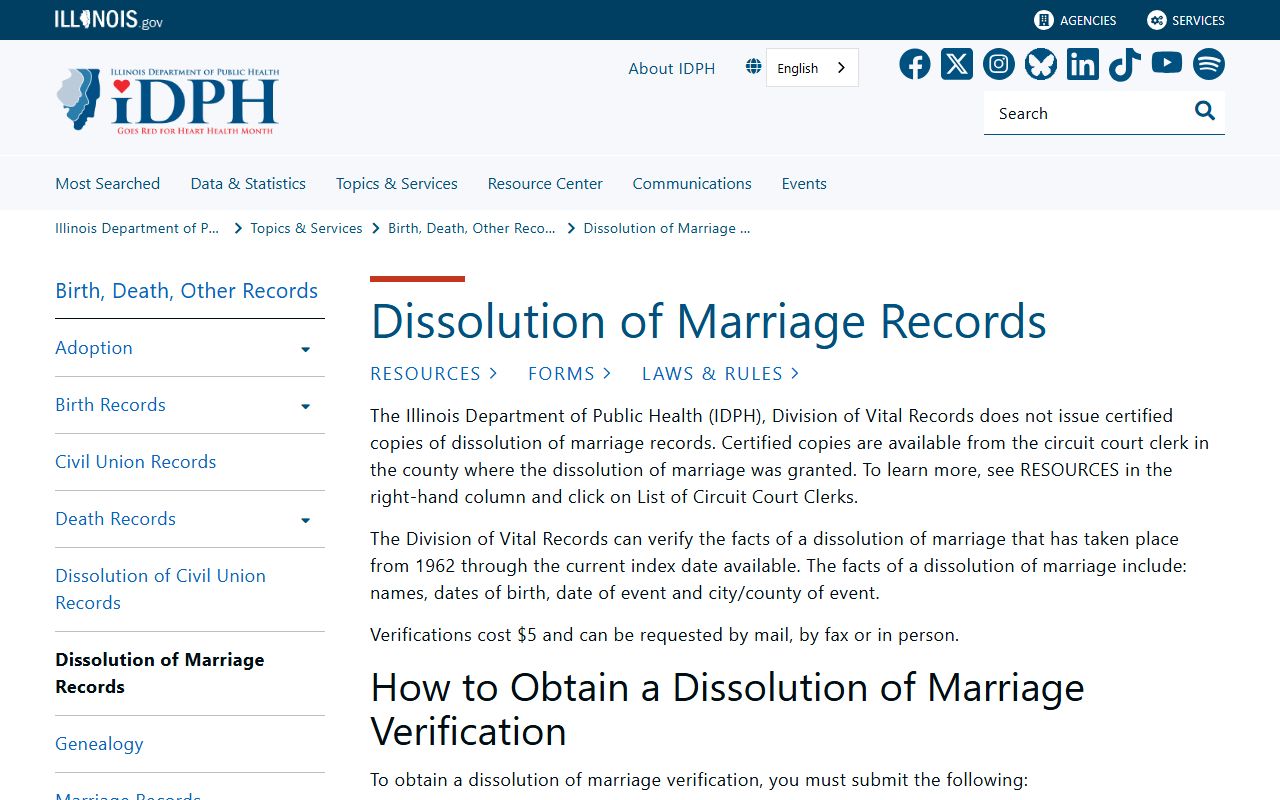
The IDPH index can confirm whether a dissolution of marriage was recorded for Marshall County cases going back to 1962.
Legal Help for Dissolution in Marshall County
Marshall County residents can access legal resources for dissolution of marriage cases through several channels. Illinois Legal Aid Online at illinoislegalaid.org provides free guides on the entire dissolution process. This includes how to fill out forms, what to expect at court hearings, and how to handle issues like child custody and property division in Illinois.
Prairie State Legal Services or Central Illinois legal aid organizations may serve Marshall County residents who meet income guidelines. Call their intake lines to check eligibility. The Marshall County Bar Association or the 10th Judicial Circuit's local bar can refer you to family law attorneys in the area. The Illinois Courts standardized forms for dissolution of marriage are available at illinoiscourts.gov and work in Marshall County court.
Note: If your dissolution involves contested custody or significant property, it is worth consulting an attorney even if you plan to handle most of the case yourself.
Cities in Marshall County
Marshall County includes Lacon, Henry, Toluca, and Sparland among its communities. All dissolution of marriage cases from anywhere in Marshall County are filed with the Circuit Clerk in Lacon. No cities in Marshall County meet the 50,000 population threshold for a dedicated city page.
Nearby Counties
These counties border Marshall County. File your dissolution case in the county where you or your spouse currently lives under Illinois law.